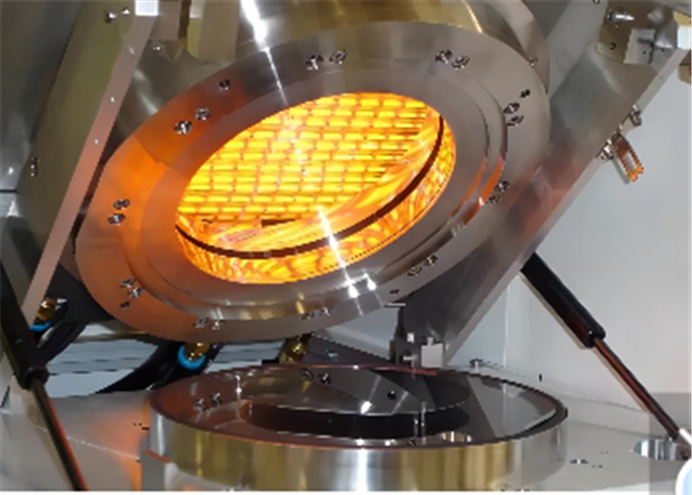
On the packaging line, substrate temperature isn’t a background knob—it’s the line in the sand between a repeatable run and scrap. If your heating lamp drifts or throws hot spots, you’ll see it right away: photoresist profile shift after soft bake, line-width excursion after hard bake, and etch non-uniformity that only shows up too late. We built this substrate heating lamp for one job: keeping thermal control when production is pushing hard. What matters, technically We run NIR quartz-halogen emitters tuned for fast, directional heating with minimal substrate thermal lag. The whole point is uniformity: ±0.1°C across the heated zone, backed by a calibrated thermal map. The system is cleanroom-compatible from Class 1 to Class 100, and we verify zero particle generation with in-situ monitoring. Output stays repeatable within ±0.3% around the clock, and we’ve seen units run 5,000+ hours with less than 5% output drop. Ramp and soak are handled by a closed-loop thermal controller that stays locked to the process recipe. Here is why it holds up in real packaging work: substrates have tight thermal budgets, and photoresist bake windows are narrow. When soft bake is stable, solvent removal is consistent—fewer footing issues and less residual film. Tight hard bake repeatability keeps the post-bake profile under control, which translates into more predictable etch behavior and better dimensional control. The payoff is fewer rework lots, less unplanned downtime, and lower energy use because the temperature settles faster with less overshoot. A couple of practical notes. NIR heating is line-of-sight, so lamp-to-substrate distance has to be fixed and repeatable—otherwise uniformity drifts. Expect a short commissioning period to align the thermal map with the substrate stack and tool geometry. The lamp works with standard packaging substrate fixtures, but if you’re integrating into a legacy line, you may need a small mechanical adapter and a dedicated power/controller interface.